Prepared exclusively for Culina Group · 7 May 2026

How Culina
wins the next
decade of logistics.

Tech and AI as a competitive lever, not a productivity tool. Department-specialised agents trained on logistics work, deployed on top of any system of record — Paragon, SAP, Oracle, Microlise — with no migration required.

5
Operating clusters
5
Key departments for AI agents
Weeks
From workshop to live agent
300+
Global logistics deployments
👤
Culina Operations Team
Approves exceptions · Sets strategy · Overrides agents
HITL Controls — approve, override, escalate
🤖
AgentFleet Co-Workers
Executes · Monitors · Escalates · Reports 24/7
Customer Transport Driver Mgmt Carrier Mgmt Settlements Customer Experience
MCP Connectors — reads & writes, no migration
🗄
Systems of Record (unchanged)
Paragon · SAP · Oracle · Microlise · Boomi
Scroll

Tech and AI is how the next decade
of logistics gets won.

Traditional logistics operators face pressure from tech-native competitors who use software and AI to take share. The companies winning are not the ones with the most assets. They are the ones turning their operating model into a competitive lever.

Operational efficiency
Cost-to-serve falls when manual coordination, exception handling, and tracking shift to agents that work 24/7 without escalation cycles.
New operating models
Tech-native operators are building service offerings around what AI makes possible — predictive SLAs, autonomous CX, dynamic pricing — that legacy LSPs cannot match on legacy stacks.
📈
Market share
Customers consolidate volume with operators who deliver better visibility, faster resolution, and cleaner financial reconciliation. AI is the lever that delivers all three.

The right question for Culina is not whether to deploy AI. It is how fast the operating model can be re-engineered before tech-native competitors compound their lead.

Five clusters.
Five operating models.

Culina Group operates across five distinct clusters — each with different systems, operational profiles, and AI applicability. The right AI deployment sequences by cluster, not group-wide.

FMCG Ambient Distribution
Great Bear · MMi Distribution · Culina Logistics · Warrens
Cold Chain & Fresh
Fowler Welch · Eddie Stobart
Palletised Network
TPN
E-Commerce & Returns
iForce
Specialised & European
IPS · Stobart Europe · IRF · CML

Where AI fits across
Culina's priorities.

The AI layer that actually moves the needle is one that understands how logistics businesses run — not one that has to be taught.

Functional Priorities

  • Build a group-wide AI-ready operating model — compete with asset-light, AI-first players taking market share
  • Start with highest-impact operational workflows — control tower, CX, carrier, driver, and settlement processes
  • Sequence adoption by business cluster, not group-wide — FMCG, fresh produce, ambient, and automotive each differ operationally
  • Run a structured diagnostic on one or two businesses — pinpoint inefficiencies and validate AI use cases with evidence

Technical Imperatives

  • Design AI for a heterogeneous systems landscape — deliver value now, without waiting for full platform consolidation
  • Establish three clear AI deployment pathways — core platforms, non-core systems, and custom agent development capability
  • Build a system-of-action across existing systems — connect operational data and enable faster decisions across the group
  • Choose domain AI over horizontal platforms — logistics ontology and context outperform general-purpose AI tools
  • Lay the data and knowledge foundations early — shared data access and governance must precede group-wide AI scale

Outcomes. Velocity.
Best-in-class.

Three things matter in AI for logistics. Measurable outcomes, not productivity claims. Velocity from diagnosis to live agent. And a point of view about what works — pre-done, not DIY.

Outcomes
Defined KPIs per department — not vague AI productivity claims. Every deployment targets measurable results tied to your P&L.
Velocity
From diagnosis to live agent in weeks, not quarters. Pre-built logistics intelligence means no blank-page training time.
Best-in-Class
The only agentic AI platform built exclusively for logistics — with deep domain knowledge baked in, not bolted on.

A department-first
AI organisation.

Today, the operating knowledge of a logistics business lives in 6,000 heads across 52 countries. Job descriptions are stretched, tribal knowledge holds you hostage, and information asymmetry blocks change. We have specialised agents for the departments that actually run logistics businesses — trained on the JDs, the workflows, and the exception patterns.

AgentFleet mirrors your org. Every department gets a supervisor agent that manages the workflow and task agents that execute. Humans stay in control through explicit approval gates and a real-time command centre.

Organisation

AgentFleet — Culina Group

One unified AI platform spanning all clusters and departments. Governed by a shared policy layer, with full audit trail and HITL controls.

Customer Transport
Driver Management
Carrier Management
Settlements & Finance
Customer Experience
Teams

Department AI Teams

Each department has a dedicated team of agents scoped to its workflows, data access, and KPIs.

💬
CS Team
Customer service workflows, query resolution, escalation routing
🚛
CT Team
Transport planning, exception handling, delivery monitoring
⚙️
Ops Team
Carrier performance, driver compliance, fleet utilisation
💳
Finance Team
Invoice processing, dispute resolution, settlement reconciliation
Supervisor Agents

Orchestration Layer

Supervisor agents manage workflows end-to-end — delegating to task agents, monitoring outputs, and escalating to humans when thresholds are breached.

CX Co-Worker — Customer Experience
CT Co-Worker — Customer Transport
Ops Co-Worker — Operations
Finance Co-Worker — Finance
Task Agents

Execution Layer

Specialised agents that perform discrete tasks — each governed by an explicit policy, with defined permissible actions and approval requirements.

ETA prediction & proactive re-routing
Driver hours compliance monitoring
Carrier invoice validation
POD capture & exception flagging
Query classification & auto-resolution
Freight audit & discrepancy detection
Dynamic load optimisation triggers
SLA breach early warning
Carrier performance scoring

Every department.
Measured outcomes.

🗼
Control Tower
65%
faster exception resolution
Zero coordinator overhead
Monitors network, surfaces exceptions
Triggers resolution autonomously
Pre-alerts · SLA monitoring
Delivery coordination
🚛
Driver Operations
20%
productivity uplift
Real-time driver guidance
Coordination b/w ops · customer · driver
Slot planning · driver coordination
Mobile-first comms
🤝
Carrier Operations
10–12%
ops team productivity uplift
Automated slot management
Intelligent schedule management
Carrier communications
3PL performance monitoring
💷
Settlements
50%
workload reduced
Auto-generates invoices & settlements
Dispute resolution agent
Invoice disputes · Driver payouts
Revenue leakage detection
💬
Customer Experience
30%
fewer queries
All customer/consumer coordination
Inbound + outbound handled by AI
Appointment booking · WISMO
B2B + B2C communication management

Where each agent fits
across Culina's clusters.

Cluster Companies Control Tower Driver Management Carrier Management Settlements Customer Experience
FMCG Ambient
Great Bear · MMi Distribution · Culina Logistics · Warrens
Core
Staging Congestion · Multi-Leg Visibility
Core
Dock Slot Sequencing · Departure Adherence
Core
Slot Confirmation · SLA Re-Tender
Core
4-Way Match · Invoice Freeze
Core
Proactive ETA Push · Failure Patterns
Cold Chain & Fresh
Fowler Welch · Eddie Stobart
Core
Appointment Monitor · Inbound Forecast
Core
Dock Slot Sequencing · Temp Excursion Alert
N/A N/A Core
Pre-Arrival Alert · Exception Claim
Palletised Network
TPN (56 depots, 5,500+ hauliers)
Core
Inbound Forecast · Scan Audit
Strong
No-Show Detection · KYC Compliance
N/A N/A Core
ETA Notification · WISMO Resolution
E-Commerce & Returns
iForce
Core
Priority Dispatch · Returns Classification
Applicable
Pre-Delivery Call · POD Quality Check
Strong
Outbound Slot · Reliability Monitor
Core
Claims Adjudication · Automated Settlement
Core
WISMO Resolution · Post-Miss Recovery
Specialised & European
IPS · Stobart Europe · IRF · CML
Core
Port Clearance · Cross-Border Visibility
Core
Fatigue Detection · HOS Compliance
Core
CO₂ Tracking · Trial Lane Gating
Strong
Detention Billing · Ad-Hoc Charges
Strong
ETA Communication · NPS Escalation

Two paths to AI
in logistics.

The horizontal pitch sounds attractive. One platform, build anything. In practice, it pushes the entire training, integration, and ontology problem onto your team. The specialist path arrives pre-trained on the exact workflows that move logistics KPIs.

DIY Horizontal Platform

Build it yourself

Generic AI tooling that requires your team to define every workflow, train every model, and stitch every integration — with no logistics knowledge built in.

  • Months to first meaningful output
  • No domain expertise — you write every SOP
  • Fragile integrations with TMS / WMS / Telematics
  • No benchmark KPIs — you define what success looks like
  • Your team maintains model quality over time
  • High internal resource cost and delivery risk
Shipsy AgentFleet

Pre-built. Pre-trained. Pre-done.

Purpose-built logistics agents that arrive with domain knowledge, pre-integrated connectors, and proven KPIs — so you deploy to outcomes, not experiments.

  • Live in weeks — diagnostic → blueprint → deploy
  • 10+ years of logistics intelligence built in
  • Native connectors for Paragon, SAP, Oracle, Blue Yonder
  • Validated KPIs from 300+ deployments globally
  • Continuous agent performance monitoring included
  • Fixed-cost FDE model — predictable investment

Go deep on one.
Then scale.

We don't deploy across every department on day one. We pick the highest-value workflow, build it end-to-end with full policy governance and integration, prove the ROI — then scale iteratively across your BUs and departments.

01
Discovery
Map all existing workflows, data sources, and pain points across target departments
02
Opportunity Assessment
Quantify ROI potential and prioritise the highest-value use case to start
03
Solution Design
Define agent architecture, data flows, integration points, and governance policies
04
Integration & Data
Connect to your BU stacks via MCP connectors — Paragon, SAP, Oracle, Blue Yonder
05
Agent Build & Test
Build agents, configure HITL policies, red-team for robustness and bias
06
Controlled Rollout
Deploy to a single cluster first, track KPIs, iterate within sprint cycles
07
Scale & Expand
Roll out proven agents across all BUs, adding new departments iteratively

Governance Principles

  • Every agent decision is governed by explicit policies, not opaque model behaviour
  • Humans are in the loop at every critical decision point via HITL gates
  • Each agent is evaluated for factual accuracy, action correctness, and red-team robustness before go-live
  • Diagnostic-led: map baseline, identify friction, spot agentable workflows, quantify value — before any deployment
  • Sequence by cluster, not group-wide — FMCG, fresh, ambient, and specialist each differ operationally
  • Three deployment pathways: core Shipsy platform, non-core BU stacks via MCP connectors, and custom agent capability
  • Pilot → Scale → Autonomy: prove one workflow fully, then replicate across BUs using the same blueprint

System of Action
over System of Record.

Shipsy AI doesn't replace your existing systems. It sits as a System of Action above your Systems of Record — connecting to every BU's stack, normalising data, and executing decisions in real time. Two paths, one outcome.

Path A

Shipsy Core + AI

For BUs adopting Shipsy TMS/WMS as the system of record. Native integration — no connectors, no latency, no data mapping overhead.

  • Shipsy TMS as the operational backbone
  • Native Shipsy WMS integration
  • AgentFleet natively connected to all data
  • Zero connector overhead — direct data access
  • Fastest path to go-live
Path B

Your Stack + Shipsy AI

For BUs retaining existing systems — Paragon, SAP TM, Oracle TM, Blue Yonder, Manhattan. No migration required.

  • MCP connectors per BU's existing stack
  • Knowledge Graph + Context Layer for entity normalisation
  • Cross-BU data unified without touching source systems
  • Paragon · SAP TM · Oracle TM · Blue Yonder · Manhattan · Microlise · Dynamics
  • No migration, no disruption — AI layer only
⬆ System of Action — Shipsy AgentFleet
Agent Orchestrator (LangGraph)
Observability Engine
Memory & RAG
Knowledge Graph
AgentFleet Command Center
HITL Controls
Comms Channels
reads & writes both directions — no disruption to existing systems
Connector Layer
API / MCP Connectors
Event Streams / Kafka
Carrier Track & Trace
IoT & Telematics (Cold Chain)
Document Ingestion
syncs with existing stack — zero migration required
System of Record — Culina's existing stack (unchanged)
ERP (SAP / Oracle / Dynamics)
TMS (Paragon / Blue Yonder / Descartes)
WMS (Manhattan / Blue Yonder / SAP EWM)
Telematics (Microlise / Webfleet)
Carrier & CRM (Oracle CX / Salesforce)

Proven at scale.
In logistics.

Three deployment patterns. Three out of four customers below are not on Shipsy as a system of record. AgentFleet works on top of any logistics stack — that is the point.

UPS
Healthcare Supply Chain · B2B CX
Watch case study
Shipsy Core + Shipsy AI
UPS — Healthcare Supply Chain
Autonomous customer service across B2B logistics — agents handling the 80/20 of inbound and outbound coordination
CX agents resolve customer queries, coordinate exception handling, and trigger autonomous outbound calls when temperature parameters approach the 80% threshold for cold-chain pharma shipments. At 95%, ops is escalated. Built natively on Shipsy TMS — zero integration overhead.
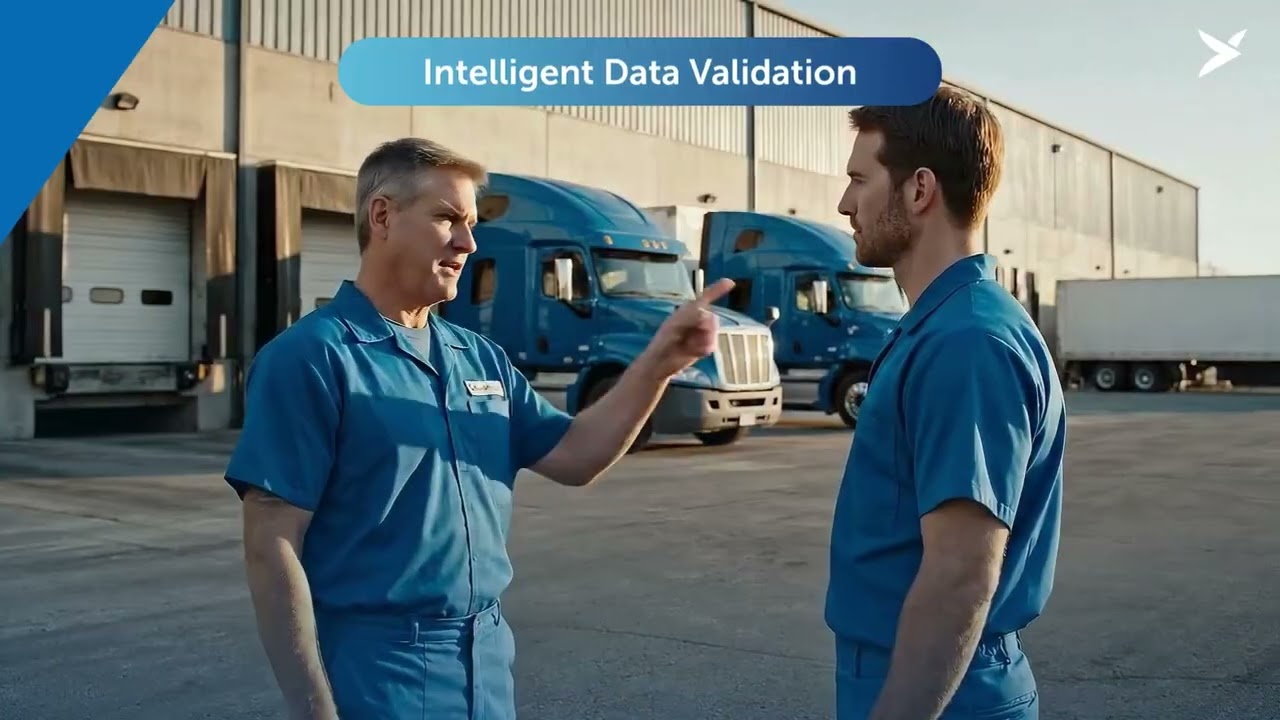
Heineken case study
Heineken — Dispute Resolution Agent
Shipsy Core + Shipsy AI
Heineken
Solving vendor financial disputes autonomously via dispute resolution agent
53
human agents' work automated
121 hrs
1st response time — 80th percentile
572 hrs
resolution time — 80th percentile
Legacy Stack — agents deployed without migration
iTrack Suite
iTrack Branch 145 instances
No shared view across branches
iTrack Central Hub
Receives routes from all 145 branches
custom connector
AWS Lambda
Brittle glue — not built to scale
Custom-built
routes feed
RoadNet (Omnitracs)
Planned a week ahead — can't adapt in real-time
Static
field layer
GeoTrack
Live GPS — best real-time signal
bTrack
Legacy HHT — check-ins & missed stops
Non-Shipsy Core + Shipsy AI
$5.3B Global Secure Logistics Player
5 agents deployed on top of legacy stack — RoadNet, iTrack, GeoTrack — without replacing any system
30–40%+
manpower savings
60%→80%+
fleet utilisation
145→1
branch instances unified at the agent layer
SLA Monitoring · Dispatch & Allocation · Route Security · Dwell Time Monitor · Driver Assist. The system of action sits above the legacy SORs — proves AgentFleet does not require a Shipsy core.
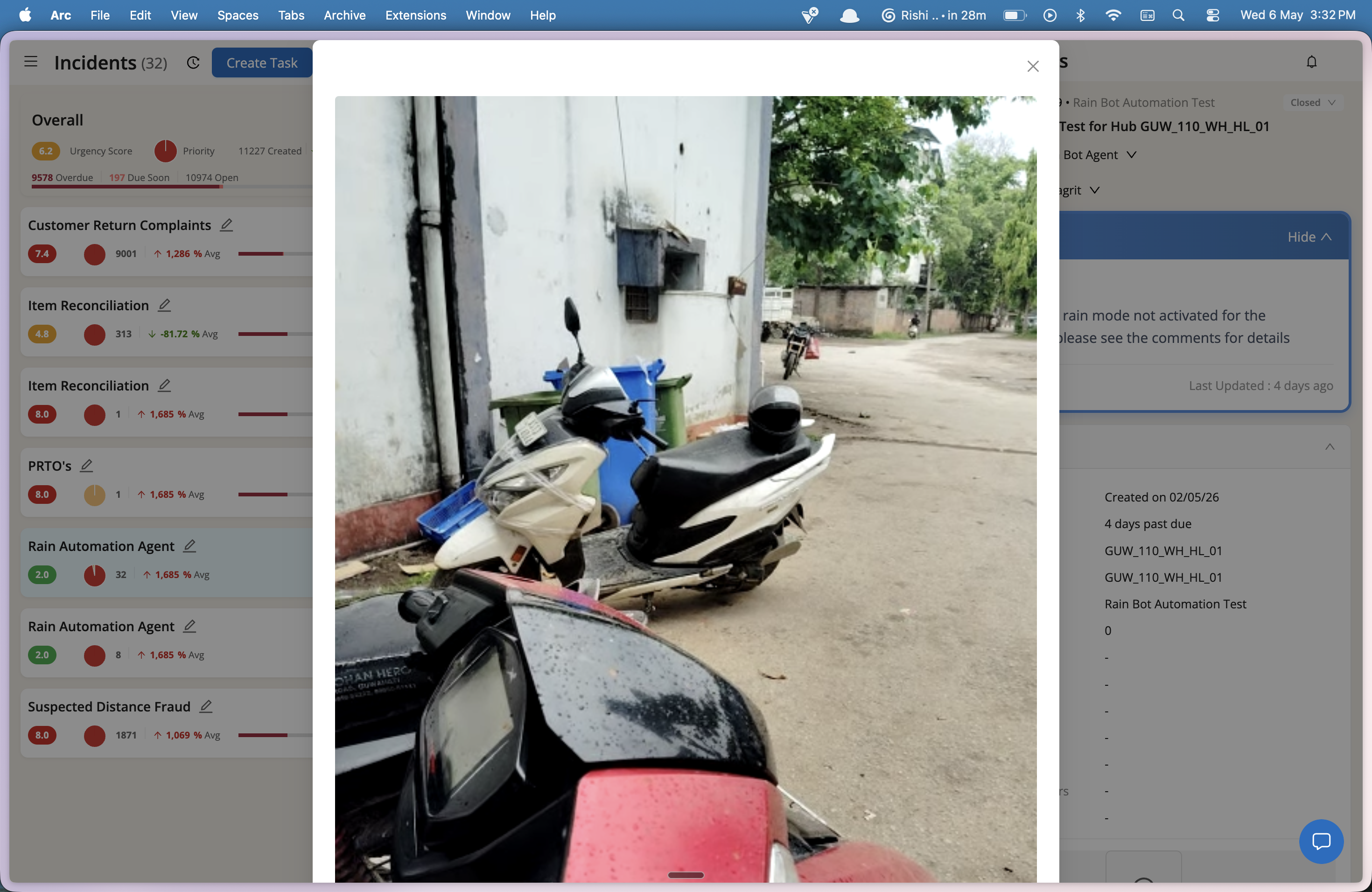
Walmart Flipkart RainBot
RainBot — live incident: staged/artificial rain detected near camera
AgentFleet Standalone
Walmart / Flipkart
Custom agent built on Agent Builder — detecting fake delivery attempts using rain conditions at the delivery location
50–53M
unique visitors in 2025
800+
stores across 14 cities
5M+
orders per month in leading markets
RainBot agent built using Shipsy Agent Builder on top of Walmart/Flipkart's own systems. Analyses rain conditions, concludes "staged/artificial rain near camera," flags fraud autonomously. Proves the agent layer is fully independent of the Shipsy SOR.

Architecture & key
components.

Seven layers — from system of record to full observability. Each layer is purpose-built for logistics, not adapted from a generic AI stack.

Observability
Audit Logs
Monitoring Key Metrics
Feedback & Real-Time Alerts
Security
Guardrails
Evaluation & Drift Detection
Models
Closed-source LLMs (OpenAI · Gemini · Claude)
Open Source Models (Mistral · Llama)
Vision & Speech Models
Rule-based Proprietary Models
Memory
Short-Term Memory (Conversation Context)
Long-Term Memory (Vector DB)
Orchestration
LangGraph-based (open source)
Multi-Node Workflow
Maintains State
Tools
Event-based Triggers
Custom APIs (Shipsy · Geocoding)
MCP Server
Telephony Integration
System of Record
Shipsy WMS / TMS
ERPs (SAP · Oracle · Dynamics)
EDMS
CRMs

Modular and customisable
for every SOR use case.

Models
  • Closed-source API Models (OpenAI, Gemini, Claude)
  • Open-Source Models (Mistral, Llama)
  • Fine-Tuned Domain-specific Logistics Models
Deployment Options
  • Cloud (default)
  • On-Premise
  • Hybrid — on-prem vector DB + online model calls
Integrations & Tools
  • 3rd Party: ERPs, CRMs, TMS/WMS
  • Telephony via SIP Trunking (Aviva / local providers)
  • MCP connectors per BU stack
Memory Store
  • Pinecone (default)
  • Open-source Vector DBs (FAISS)
  • Graph DB

Logistics-specific policies.
Built for ops, not retrofitted.

Guardrails + HITL
  • Confidence score driven human escalation — low-confidence outputs never auto-execute
  • HITL Chat interface built in; no separate workflows or portals required
  • Every permissible agent action is explicitly listed — nothing outside the policy set can execute
Eval Policy
  • Every agent has a linked evaluation policy — accuracy, action correctness, red-team robustness
  • Production outputs sampled and scored continuously
  • Drift triggers an alert and gates the agent from high-stakes actions until reviewed
Example — Follow-up Policy

Agent identifies a driver wants a callback in 30 min → follow-up created with time tracking → auto-triggers at the right time, considering time zone, preferred channel (call/WhatsApp), and no-answer escalation logic.

8 building blocks
driving agent actions.

01
Role definition + information access
System Prompt + Context
02
SOPs
Grounding (RAG), authored in Docs with versioning + approvals
03
RBAC (Access Control)
AI Employee RBAC
04
Permissible actions
Tools (MCPs)
05
Approval workflows
Human in the Loop (HITL)
06
Manager feedback
Real-time supervision by agent
07
Performance Reporting
Agents Performance Analytics
08
Memory and context graph
Persistent entity knowledge across sessions

Continuous improvement loop
from pre-deployment to production.

01
Scenario-Based Eval Sets
Dedicated test set per agent use case. Covers edge cases, adversarial inputs, and high-frequency logistics scenarios.
02
Pre-Deployment Testing
LLM-based evaluators run against eval set. Accuracy, hallucination rate, action correctness — all scored before go-live.
03
Human Feedback Loop
Users rate agent outputs via UI. Ratings feed back into vector DB and training examples for model improvement.
04
Continuous Prod Evals
Drift detection via canary tests. A/B benchmarking on prompts and model variants. Anomalies trigger alerts — not silent degradation.
Evaluation Metrics: Factual accuracy · Correctness of actions · Red-team robustness (adversarial) · Bias & fairness · Language tone & clarity

Trigger framework — maps ops
signals to executable agent work.

Step 01
Work Creation
Observability layer detects operational signal → Incident or task automatically created with full context attached.
Step 02
Work Assignment
Task assigned to AI workforce. Supervisor agent determines priority, routes to the correct task agent.
Step 03
Work Execution
Agent executes with full context — SOP grounding, relevant history, permissible action set. No guesswork.
Step 04
Manager Intervention
HITL available at any node. Supervisor reviews, approves, overrides, or escalates. Full audit trail logged end-to-end.

Configure, clone, and deploy
in minutes.

Enterprise control over every node — autonomous by default, auditable at every step. Start from a pre-built logistics agent or build from scratch.

Agent Builder — How it works
Configure · Clone · Deploy  ·  Full product walkthrough
1

Clone or create

Start from a pre-built logistics agent — RainBot, QC Inspector, Follow-Up Agent — or build from scratch.

2

Configure scope

Assign to specific depots, regions, or BUs. One config, redeployable across Great Bear, TPN, Fowler Welch.

3

Attach tools

Pick from a logistics tool library — Control Tower, Carrier API, POD ingestion, telephony trigger, and more.

4

Set policies

Add retry, follow-up, eval, and HITL policies. Define confidence thresholds — explicit rules, not opaque behaviour.

5

Add custom SOPs

Paste any SOP or prompt. Agent grounds decisions against Culina's procedures — not generic best guesses.

Enterprise control: every agent decision governed by explicit policies — confidence thresholds, escalation rules, and full audit trail

Mobile-first HITL — because
logistics doesn't sit at a desk.

Agents need help. The question is whether your supervisors can act on that help when they are on a yard, on a dock, or in transit. Most AI tooling pushes review into a desktop dashboard. Ours puts approve, override, and escalate into the supervisor's phone.

HITL in Action — live across desktop & mobile

AgentFleet Command Center

Every agent decision visible, auditable, and approvable in real time. No desktop bottleneck — supervisors approve, override, or escalate from any device.

🤖
My Agent Fleet
AI Operations Dashboard
ON-TIME ORDER
94.2%
AVAILABLE RIDERS
47 / 52
NEED MY INPUTS
6
AGENT TASKS
10
AVG DELAY
8.5 min
My Agent Fleet ▾
All Status ▾
All Hubs ▾
Today ▾
✓ 3 ▶ 1 ⚠ 5 ⊗ 1
All (10) Need my inputs 6
#338 Interrupted
Trip delayed — Multiple orders at risk of SLA breach
Trip: TRP-NOI-78500
⚠ Need my input
#336 ▶ Running
Address enrichment in progress — Geocoding complete
Consignment: CN-78800
#333 Interrupted
Low confidence address — Multiple possible matches
Consignment: CN-78789
⚠ Need my input
#339 Interrupted
Order OFD — No movement for 8 minutes
Consignment: CN-78234
⚠ Need my input
#334 ✓ Success
Pickup delay detected — Auto-resolved after rider movement
Consignment: CN-78100
Agent Task #329 ⊗ Failed ⚠ Need my input
Vehicle Stoppage > 10 min detected
🚗 Vehicle: VEH-TN01AU4614 # EVENT-12194 ↑ Source: GPS Tracker
CREATED
05 Feb 2026, 01:22:05 pm
STARTED
05 Feb 2026, 01:22:06 pm
COMPLETED
05 Feb 2026, 01:22:10 pm
RUNTIME
4s
VEHICLE NUMBER
TN01AU4614
VEHICLE TYPE
Two Wheeler
RIDER NAME
Kamal
CURRENT HUB
NOIDA-S62
🤖 AI Summary Agent Task : 329 Hide ↑
📄 Details Captured
Vehicle TN01AU4614 has been stationary for 12 minutes at Sector 62, Near HP Petrol Pump. Rider Kamal has 94% on-time history.
● Next Steps
Awaiting OFE action to verify rider status.
Last Updated : 12 mins ago
Intervention Required 1 of 3  ›
⚡ Live AI Task Stream LIVE
Real-time AI actions across all agents
✓ COMPLETED Cluster rebalancing completed 87%
✓ COMPLETED Cluster rebalancing completed 92%
✓ COMPLETED Auto-resolved delivery delay 91%
⚠ ESCALATED Low confidence score 74%
⚠ ESCALATED Low confidence score 73%
✓ COMPLETED Trip reassigned to nearest rider
Good Morning, Ravi
● Shift 1 · 5 agents active
NOI-62 ▾
📊 KPIs swipe →
📋
All Tasks
2 need input · 6 running
14
🔥
Urgent SLA
oldest: 23m ago
3
2 INPUT
🚛
Vehicle Stoppage
92% auto-resolved
5
📦
OFE Escalations
1 need input
4
Completed Today
avg 4.2 min resolution
12
🏠
Home
📋
Tasks

Activity
Good Morning, Ravi
🩺 Agent Health Today ▾
🚛
Stoppage
92%
📦
OFE
89%
🤳
Selfie
78%
👤
Attend.
95%
📍
Address
84%
🏠
Home
📋
Tasks

Activity
⚡ Agent Activity All Agents ▾
OFE Assist — Reassigned order to nearby rider Arun (2.1km)
TSK-4012 RESOLVED
Vehicle Stoppage — Auto-call failed, escalated to supervisor
TSK-4001 ESCALATED
Address Intel — Geocode corrected 96% confidence
TSK-4008 RESOLVED
Attendance — WhatsApp sent to 3 unconfirmed riders
TSK-4015 MONITORING
Selfie Valid. — Batch validated 12 selfies, 11 passed
TSK-4016 RESOLVED
View all in Activity →
🏠
Home
📋
Tasks

Activity
Good Mo...
KPIS
Hub: NOI-62 Service: Express
Pickup %
94.2 %
↑ 2.1
FAD %
87.6 %
↑ 1.3
AI Resolve Rate
72.8 %
↑ 4.5
Avg TAT
4.2 min
↓ 0.8
Active Tasks
14
+3
🏠
Home
📋
Tasks

Activity

Built for logistics.
Not adapted for it.

Shipsy's AI platform is grounded in a logistics-specific data lake, knowledge graph, and integration library built over a decade — so every agent arrives with domain context that generic AI platforms take years to develop.

🔌
ERP
SAP · Oracle · Microsoft Dynamics
🗺️
TMS
Paragon · Blue Yonder · Descartes · Bespoke
🏭
WMS
Manhattan · Blue Yonder · SAP EWM
📡
Telematics
Microlise · Webfleet · Teletrac Navman
🤝
Carrier & CRM
Oracle CX · Salesforce · 3PL APIs

How Shipsy AI Connects to Culina's BU Stacks

Culina's BU SORs (indicative list, outside-in)
  • Paragon (TMS)
  • SAP TM
  • Oracle TM
  • Blue Yonder
  • Manhattan (WMS)
  • Microlise
  • Dynamics 365
Connectors
  • API / MCP per BU
  • Event Streams / Kafka
  • Carrier Track & Trace
  • IoT / Telematics
  • Document Ingestion
Intelligence Layer
  • Agent Orchestrator
  • Observability Engine
  • Memory / RAG
  • Knowledge Graph
  • Context Layer
Outputs
  • Command Center Dashboard
  • Communication Channels
  • HITL Approval Flows
  • Mobile & Desktop
Governance
  • Guardrails & Policies
  • Data Residency
  • Access Control
  • Audit Trails
  • Hallucination Control

Four things every
logistics AI deployment hits.

Every AI deployment in logistics runs into the same four problems. We have hit each of them at scale, found the answer, and built it into the platform. Generic AI vendors will hit them in production at Culina's expense.

01
cold start → hot start
The cold start problem
Generic platforms need your SOPs to begin. Most logistics ops do not have clean SOPs — the knowledge lives in operators' heads. Our agents arrive pre-trained on logistics SOPs across 300+ deployments, then ingest your operational data to extract customer-specific procedures from what actually happens.
What this looks like
Day one, the CX agent already knows how a missed-delivery exception is triaged in 80% of LSPs. By week three, it has learned Culina's specific exception patterns from the ticketing history.
02
tribal knowledge → extracted SOPs
Knowledge stays in heads
Coordinators, dispatchers, and CX leads carry the playbook in their head. When they leave, the operating knowledge leaves with them. Our deployment agents analyze ticketing history, email threads, and existing docs to auto-generate SOPs from observed behaviour — not aspirational documentation.
For Culina
We expect to extract working SOPs from 3–6 months of operational data per cluster, then validate with the floor team. No 18-month documentation exercise required up front.
03
dirty data → common data lake
Agents need a clean data lake
Agents fail silently when master data is duplicate, fragmented, or inconsistent across SORs. Our ontology mimics logistics standards (OTM-style data model). Custom object model plus connectors plus transformation layer creates a common data lake your agents can reason over — without forcing a master-data migration first.
For Culina's heterogeneous stack
Paragon, SAP, Oracle, Microlise, and Boomi can be unified at the intelligence layer before any consolidation at the SOR layer. Boomi remains your integration backbone — the data model lift happens on our side.
04
desktop AI → field-ready AI
HITL has to be where ops works
An agent that asks for approval but only gets it 4 hours later when the supervisor is back at a laptop is no better than an automated email. Our HITL surface is mobile-first, cross-platform, with approve / override / escalate available from any device. Supervisors never become the bottleneck.
Why this matters
Operations runs on yards, docks, and during transit. AI tooling that ignores that reality bottlenecks every escalation. Mobile-first HITL is the difference between agents that scale and agents that pile up unresolved tasks.

Diagnostic and business case
driven from day one.

Our 7-step engagement approach

1
Understand the baseline

Map systems, volumes, business KPIs, and user workload

2
Identify friction points

Surface manual tasks across planning, execution, finance, and customer service

3
Spot "agentable" workflows

Prioritise repetitive, high-effort, high-impact processes suitable for AI agents

4
Quantify value

Estimate labour hours saved, SLA improvements, cost avoidance, and efficiency gains

5
Design the blueprint

Select relevant Shipsy agents and workflow packs; define policies and guardrails

6
Build CFO-ready business case

Model savings vs. implementation cost, ROI timeline, payback period

7
Align with CXOs

Present opportunities, expected outcomes, and phased rollout plan (Pilot → Scale → Autonomy)

Enabled by the FDE model

A Forward-Deployed Engineer embedded at Culina — not a remote integration project. Same-day turnaround on rule changes.

  • Shipsy engineer embedded at customer site
  • Configures agents, guardrails, segmentation rules
  • Handles integrations with Culina's BU stacks
  • Runs evals, iterates on business logic
  • Same-day turnaround on rule changes
  • Bridges the ops team and the AI system
One config. Reusable workflow packs. Scale from one depot across the entire network.

Six differentiators no generic
AI platform can match.

Culina will be pitched by horizontal AI platforms and consulting firms. Neither can compete on the six dimensions below — not because Shipsy builds faster, but because a decade of logistics deployments creates compounding advantages that can't be replicated from scratch.

🚀
01
vs. "give us your SOPs"
Hot Start — Not a Cold Start
Horizontal platforms start from zero. They need your SOPs, your documentation, your discovery work. Most logistics companies don't have clean SOPs — Culina's cross-dock operations run on a 2010-era web app and informal processes. Shipsy solves the industry's cold start problem with a hot start: agents arrive pre-loaded with logistics domain knowledge, then ingest 3–6 months of your actual operational data to auto-generate customer-specific SOPs from what actually happens — not what's supposed to happen.
Proof — Heineken
SOPs were analyzed and agents trained on existing operational documentation as part of deployment prep. No new documentation exercise required before go-live.
🕸️
02
vs. read-only AI layers
Knowledge Graph + Two-Way Sync
Horizontal AI tools sit on top and observe. Shipsy sits in the middle and orchestrates. The platform maintains live two-way connections with every system of record — it reads from WMS, TMS, ERP, carrier portals, and email, and writes back. An agent doesn't just detect a cross-dock labelling issue; it updates the order record, triggers the ASN, and pushes the correction downstream. The knowledge graph connects entities across systems that no single SOR holds: carrier performance by lane, customer exception history, depot processing patterns.
For Culina
Integration layer is Boomi. Shipsy's two-way sync can unify intelligence across CLL, CML, and Fowler Welch before their underlying systems are fully consolidated.
🧠
03
vs. generic LLM memory
Domain-Specific Memory
Generic memory systems weight everything equally — last Tuesday's weather delay gets the same treatment as a permanent delivery constraint. Shipsy's agent memory is built around logistics-specific categories: customer preferences (SSCC requirements, preferred carriers, delivery window constraints), lane characteristics (which corridors consistently underperform), exception resolution patterns (what worked, what failed), and operational tribal knowledge — the kind that currently lives in people's heads and leaves when they leave.
For Culina's Xdock
Which suppliers consistently send partial information, which retailers reject pallets for minor label deviations, which carrier combinations create timing conflicts at the dock — the agent retains and applies this systematically.
🎚️
04
vs. all-or-nothing deployment
Centralised Autonomy Control
Six Culina subsidiaries, multiple BUs, different operational maturity levels. You need to roll out AI incrementally — not big-bang across the group. AgentFleet Command Center provides a single control plane with per-agent, per-workflow, per-BU autonomy configuration. CLL's agents can be at selective autonomy while Fowler Welch (onboarded later) is still observe-only.
Observe
Agent watches and generates recommendations — no actions taken
Recommend
Presents recommended actions with evidence for human approval
Act with Supervision
Specific actions allowed above configurable confidence thresholds
Expanded Autonomy
Gradual widening based on tracked performance metrics
🛡️
05
vs. "we have guardrails"
Three-Tier Agent Safety Architecture
No horizontal player ships all three layers purpose-built for enterprise logistics. Consulting firms will promise to build it — as a 12-month custom development project.
1
Pre-release Eval
500+ simulated scenarios from historical data. LLM-as-judge scoring across accuracy, business rule compliance, tool usage. Go-live is gated on pass criteria.
2
Runtime HITL
Supervisor agent reviews every action live. Can pause mid-task before the customer or downstream system is affected. Mobile-first — approve, override, or escalate from any device.
3
Post-runtime Drift Detection
Continuous eval catches slow degradation — an agent 99% right today but drifting over weeks. Feeds back into Tier 1 automatically.
📊
06
vs. generic benchmarks
Proprietary Eval Sets from Cross-Customer Deployments
Horizontal players test against generic AI benchmarks. Consulting firms build test cases from scratch on the customer's dime. Shipsy has built proprietary evaluation sets (EWAS) from dozens of logistics enterprise deployments — encoding the specific failure modes that recur across LSPs, freight forwarders, and 3PLs: exception handling patterns, rate and pricing anomalies, compliance and regulatory gaps, integration failure modes.
What this means for Culina
When Shipsy onboards Culina, agents are already stress-tested against failure modes discovered at Aramex, Heineken, MOVIN, Apollo, and dozens of others. A horizontal player starts with zero logistics-specific eval coverage. This moat compounds with every new deployment.
One thing to note: SAP's API policy blocks horizontal AI players from connecting to core logistics platforms. Shipsy's native connectors sidestep this entirely.

Governance-first. Always.

🛡️
Guardrails & HITL
🔒
Data Residency & Privacy
👤
Access Control & RBAC
📋
Full Audit Trails
📊
Monitoring & Alerts
🧠
RAG / Hallucination Control

What you should walk
away with.

Logistics depth. Real flexibility. Pre-trained agents that arrive ready. An FD-led deployment model that proves one workflow, then expands. Fast.

01

2–3 Day Diagnostic Workshop

Embedded at Culina's site. Understand the baseline — map systems, volumes, KPIs, user workload. Surface friction points. Spot agentable workflows. Quantify value. No 6-month discovery engagement.

02

Blueprint + CFO-Ready Business Case

Agent architecture blueprint, integration design, and a CFO-ready business case: savings vs. implementation cost, ROI timeline, payback period. Present to CXOs with phased rollout plan.

03

Weeks to First Agent. Months to Value. Not 18 Months.

One workflow. One BU. Fully governed. First agent in production in weeks, not quarters. Measurable value in months. Then expand iteratively across Culina's clusters — no reinvention, same blueprint.

Ready to start?

Let's book the workshop and begin building the blueprint for Culina's AI transformation.